

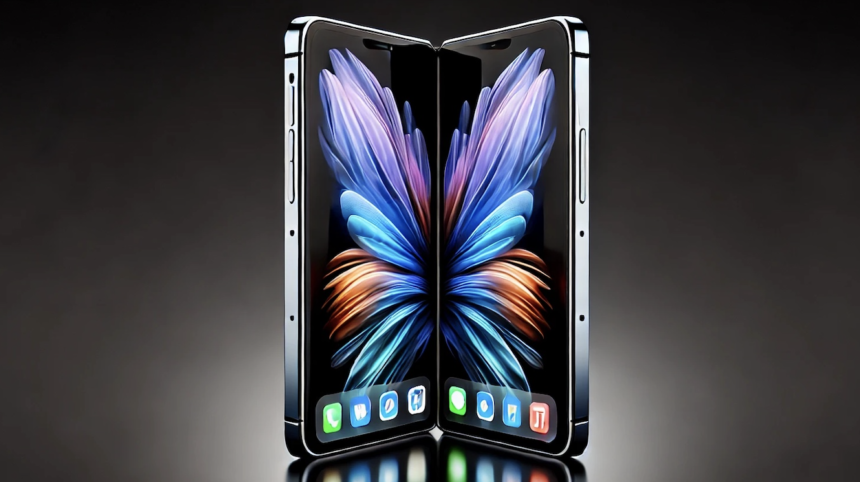
Apple is preparing to redefine the foldable smartphone category with a large-scale production strategy that far exceeds early industry predictions. Recent supply chain intelligence indicates that Apple’s long-rumored foldable iPhone is no longer an experimental side project it is shaping up to be one of the company’s most ambitious hardware launches of the decade. With massive display orders, advanced hinge engineering, and next-generation screen technologies, Apple appears to be positioning its first foldable device as a mainstream flagship, not a niche product.
This development is poised to disrupt the global foldable market, challenge Samsung’s long-standing dominance, and potentially accelerate worldwide consumer adoption at an unprecedented pace.
Apple Secures Massive OLED Supply From Samsung Display
The clearest evidence of Apple’s aggressive strategy lies in its supply chain commitments. Apple has reportedly placed an order for approximately 22 million OLED display panels with Samsung Display. This includes around 11 million primary inward-folding screens and an equal number of external cover displays.
This volume suggests that Apple is preparing to manufacture close to 10 million completed foldable iPhone units in its first production cycle. The additional panels serve as a buffer to account for manufacturing yield losses, quality control rejections, and Apple’s historically strict performance benchmarks. The scale of this order is extraordinary—especially for a first-generation product.
For perspective, the entire global foldable smartphone market typically ships just over 20 million units annually. Apple alone may be targeting nearly half that volume with a single product model.
Why Apple’s Production Target Redefines Market Expectations
Before this surge in panel orders came to light, most industry forecasts placed Apple’s initial foldable shipments between 6 and 8 million units. These conservative estimates were based on the steady but slower adoption curve of foldable devices over the past five years.
Apple’s new production goals shatter these assumptions. The company appears to be betting that:
- The foldable form factor is finally mature enough for mass adoption
- Consumer demand is ready for a premium Apple-branded foldable
- Apple’s design execution will eliminate the compromises that previously limited foldable appeal
Rather than cautiously testing the waters, Apple is preparing for a full-scale consumer rollout, signaling exceptional internal confidence.
Book-Style Folding Design With Premium Dimensions
According to reliable supply chain disclosures, Apple’s foldable iPhone will adopt a book-style inward-folding architecture, mirroring the format popularized by the Galaxy Z Fold series—but refined with Apple’s signature industrial design language.
Expected Display Dimensions
- External Display: Approximately 5.35 inches
- Internal Foldable Display: Around 7.58 inches
This configuration transforms the iPhone into a hybrid smartphone-tablet in a compact form factor. When closed, it functions as a standard smartphone. When unfolded, it offers a near-tablet visual workspace, optimized for multitasking, content creation, gaming, and immersive media consumption.
Advanced Hinge Engineering to Eliminate the Crease
One of the most persistent criticisms of foldable devices has been the visible crease that forms over time at the folding point. Apple is reportedly attacking this issue head-on with:
- A complex multi-axis hinge system
- New material composites designed to distribute stress evenly across the flexible OLED panel
- Precision-machined mechanical tolerances narrower than those used in current foldables
The goal is nothing short of making the crease nearly imperceptible under normal viewing conditions. If successful, this mechanical breakthrough alone could redefine consumer perception of foldable durability and visual quality.
Apple’s historical focus on mechanical engineering—spanning MacBook hinges to iPad kickstands—suggests this area could become one of its strongest differentiators.
Breakthrough Display Technology: Color Filter on Encapsulation (COE)
Apple’s foldable iPhone is also expected to debut Color Filter on Encapsulation (COE) technology—an advanced OLED manufacturing method that eliminates the traditional polarizer layer. Instead, color filtering is integrated directly into the encapsulation process.
Key Advantages of COE Technology
- Thinner display profile
- Higher brightness output
- Improved power efficiency
- Reduced internal reflection
- Enhanced outdoor visibility
By removing an entire optical layer, Apple gains additional internal space—space that can be reallocated toward a larger battery, reinforced hinge components, or advanced camera modules.
Under Display Camera for a Seamless Internal Screen
One of the most striking elements of Apple’s foldable iPhone is the rumored inclusion of an Under Display Camera (UDC) for the internal screen. This would allow Apple to:
- Eliminate notches and punch-holes entirely
- Deliver a fully uninterrupted foldable viewing surface
- Preserve Apple’s minimalist industrial design philosophy
Under-display camera systems have appeared in earlier foldables with mixed results. Apple, however, is expected to debut a significantly refined version, with improved pixel transparency control and AI-powered image reconstruction to ensure usable photo quality while remaining invisible during normal use.
Samsung Display as the Exclusive Panel Supplier
Samsung Display will reportedly serve as Apple’s sole supplier for these foldable OLED panels. While Apple typically sources components from multiple vendors to reduce risk, foldable OLED manufacturing at this scale currently leaves Samsung as the only supplier with sufficient:
- Production capacity
- Technical maturity
- Yield stability
- Long-term reliability
This arrangement underscores the strategic interdependence between two of the industry’s fiercest competitors. While Apple battles Samsung in the retail market, it continues to rely heavily on Samsung’s display leadership behind the scenes.
Launch Timeline Aligned With iPhone 18 Pro Series
If production and supply chain timelines remain on track, Apple’s first foldable iPhone is expected to debut alongside the iPhone 18 Pro and iPhone 18 Pro Max lineup. This positioning would instantly elevate the foldable iPhone to:
- A flagship launch status, not a side release
- A centerpiece of Apple’s annual product ecosystem
- A premium-tier offering above the Pro Max models
This timing also suggests that Apple views foldable technology not as a future experiment—but as a core pillar of its long-term smartphone roadmap.
Apple’s Entry Will Reshape the Global Foldable Market
The foldable smartphone category has historically suffered from:
- High prices
- Fragility concerns
- Visible display creases
- Limited software optimization
- Battery life compromises
Apple’s entry threatens to systematically eliminate each of these barriers. With iOS optimization, refined hinge systems, and supply chain scale, Apple is uniquely positioned to normalize foldable technology for mainstream consumers.
We anticipate several direct market effects:
- Rapid acceleration in foldable adoption rates
- Downward pressure on pricing across competing brands
- Increased investment in next-generation hinge designs
- Higher software optimization standards for large flexible displays
Once Apple enters the category, foldables will no longer be viewed as an experimental niche—they will become a central battleground of premium smartphones.
Software Optimization Will Be a Key Advantage
Beyond hardware, Apple’s true competitive advantage lies in deep iOS-level software optimization. A foldable iPhone enables:
- Advanced split-screen multitasking
- Tablet-grade desktop-style app layouts
- Dynamic UI scaling between folded and unfolded states
- New productivity workflows across Apple’s ecosystem
We expect Apple to integrate foldable-specific features into future versions of iOS, creating seamless continuity between iPhone, iPad, and Mac workflows.
Apple’s Strategy Signals Long-Term Commitment to Foldables
This level of component ordering, mechanical engineering investment, and display innovation makes one thing clear: Apple is not testing foldables—it is fully committing to them.
The foldable iPhone appears to be:
- A multi-year engineering project
- The foundation for future foldable product variants
- A bridge between iPhone and iPad form factors
- A key growth catalyst for Apple’s premium device margins
This is not a cautious market entry. It is a strategic declaration of scale.
Final Outlook: Apple Is Preparing to Dominate the Foldable Era
Apple’s first foldable iPhone is rapidly shaping up to be one of the most consequential smartphone releases in recent history. With:
- Massive OLED display orders
- Near-tablet-sized internal screens
- Advanced crease-reducing hinge technology
- Under-display camera integration
- Ultra-thin COE OLED panels
- A flagship-tier launch alongside the iPhone 18 Pro lineup
Apple is positioning itself to redefine the foldable user experience from the ground up.
We are witnessing the early stages of a shift that could reshape the smartphone industry over the next decade. The foldable category is about to move from experimental curiosity to mainstream premium standard—and Apple intends to lead that transformation at full scale.