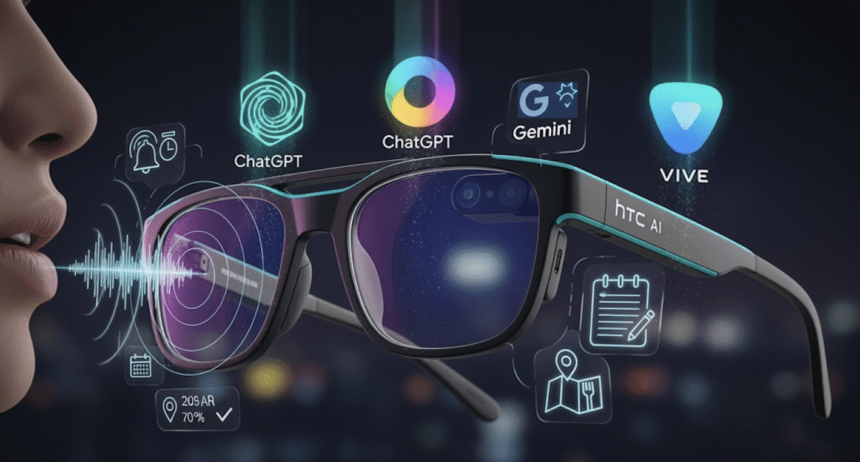
The battle for your face has officially begun. While Meta has dominated the headlines with its Ray-Ban collaboration, a new challenger from Taiwan is changing the rules of the game. In late 2025 and heading into 2026, HTC has unveiled the VIVE Eagle, a pair of AI smart glasses that does something no other wearable has dared to do:It empowers you to choose your preferred AI “brain.”
Instead of being locked into a single ecosystem, the VIVE Eagle allows users to toggle between OpenAI’s GPT and Google’s Gemini. This “Open AI” strategy is a massive shift in the industry, moving away from “walled gardens” toward a future where your hardware is just a vessel for the world’s best intelligence. In this guide, we’ll explore why AI smart glasses are the next big tech frontier and how HTC is leading the charge.
The “Open AI” Strategy: Why Choice Matters
Until now, if you bought smart glasses from Meta, you were stuck with Meta AI. If you bought from a Chinese brand, you used their domestic models. HTC’s VIVE Eagle breaks this trend.
- Gemini for Ecosystem: If you need to check your Google Calendar, find directions on Maps, or summarize a Gmail thread, you can set your glasses to use Google Gemini.
- GPT for Creativity: If you want to write a poem about the sunset you’re watching or need help solving a complex coding logic via voice, you can switch to OpenAI’s GPT.
- The “Best of Both Worlds”: Because AI is evolving so fast, HTC’s senior VP Charles Huang noted that they want users to “benefit from improvements across various models” rather than being stuck with a lagging proprietary system.
2. Design and Comfort: Looking Like Real Glasses
One of the biggest hurdles for AI smart glasses has been the “geek factor” they often look too bulky. The VIVE Eagle solves this with a minimalist approach.
- Feather-Light: Weighing in at just 48.8 grams, they are barely heavier than a standard pair of Ray-Bans.
- ZEISS Optics: HTC partnered with ZEISS to include high-quality UV400 sun lenses, ensuring that the glasses are actually useful as eyewear, not just as a gadget.
- Ergonomics: With adjustable nose pads and contoured temples, these are designed for “all day wear,” unlike the heavy VR headsets of the past.
Comparison: HTC VIVE Eagle vs. Ray-Ban Meta (2026)
|
Feature |
HTC VIVE Eagle |
Ray-Ban Meta (Gen 2) |
|
AI Models |
Multi-AI (Gemini & GPT) |
Meta AI Only |
|
Translation |
13 Languages (Real-time) |
5 Languages |
|
Camera |
12MP Ultra-Wide |
12MP Ultra-Wide |
|
Weight |
48.8g |
~49g – 50g |
|
Data Privacy |
Local Storage (AES-256) |
Cloud-Heavy (Used for training) |
|
Charging |
50% in 10 Minutes |
Standard Case Charging |
Real-World Power: Translation and Productivity
The VIVE Eagle isn’t just for taking photos; it’s a productivity tool.
- Visual Translation: Imagine walking through a market in Tokyo. You look at a menu, and the 12MP camera “reads” the Japanese text. The AI then speaks the English translation directly into your ears via the open ear spatial audio system.
- Voice-First Interaction: You can use commands like “Hey VIVE, take a photo” or “Hey VIVE, remind me to buy milk when I get home.” 3. Hands-Free Navigation: With Gemini integration, the glasses can give you turn-by-turn walking directions through your speakers, allowing you to keep your phone in your pocket and your eyes on the road.
Privacy: The “Anti-Big Brother” Approach
As AI smart glasses become more common, privacy is a major concern. HTC has made this a “key differentiator” from Meta.
- No Training on User Data: Unlike Meta, which uses interactions to train its AI, HTC claims that user data is never used for model training.
- Local Encryption: The device uses AES-256 military-grade encryption for all data stored locally on its 32GB internal memory.
- Physical Indicators: A bright LED light turns on whenever the camera is recording. If you take the glasses off or cover the light, the recording automatically stops to protect bystanders.
Technical Specifications: Under the Hood
To run high-level AI on your face, you need serious power. The VIVE Eagle is built on the Qualcomm Snapdragon AR1 Gen 1 platform, which is specifically designed for lightweight smart glasses.
- Battery Life: 36 hours of standby and about 4.5 hours of continuous music/active use.
- Connectivity: Wi-Fi 6E and Bluetooth 5.3 ensure that the connection to your phone (iOS or Android) is lag-free.
- Audio: A 4-microphone array (one directional, three omnidirectional) ensures your voice is heard clearly even in a busy city.
Global Rollout and Pricing
The VIVE Eagle initially launched in Hong Kong and Taiwan in late 2025. As we move into 2026, the rollout is expanding:
- Q1 2026: Expansion into Japan and Southeast Asia.
- Mid-2026: Launch in Europe and the United States.
- Price Point: It is priced at approximately $512 to $520, making it a premium alternative to the $299 Ray-Ban Meta. However, the price includes a 2-year subscription to “VIVE AI Plus,” which covers the API costs for GPT and Gemini.
Is the Future Finally Here?
For years, we’ve been told that “smart glasses will replace your phone.” While we aren’t there yet, the VIVE Eagle feels like the first real step. By removing the restriction of a single AI model, HTC has made a device that adapts to the user, rather than forcing the user to adapt to the brand.
If you are someone who uses Google for work but prefers ChatGPT for creative brainstorming, these are the only AI smart glasses on the market that cater to your lifestyle.
Conclusion
HTC’s return to the consumer hardware space with the VIVE Eagle is a bold move. By betting on an “Open AI” ecosystem, they are offering a level of freedom that Meta and Apple currently do not. As AI models like GPT-5 and Gemini 2.0 continue to launch in 2026, VIVE Eagle users will be the first to experience them directly on their faces.
The message from HTC is clear: The future of AI shouldn’t be a closed loop. It should be as open as the world you see through your lenses.