Introduction
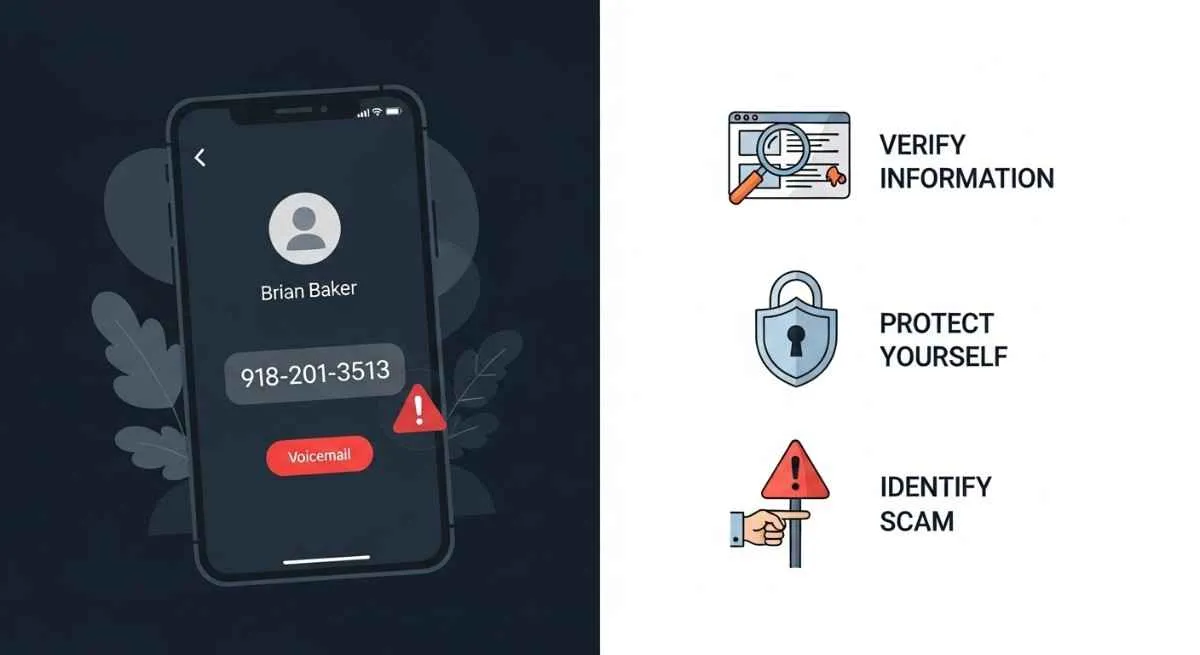
If you’ve received a voicemail from 918-201-3513 claiming to be from “Brian Baker” with a legal department or sheriff’s office, you’re not alone. Thousands of people across Oklahoma and beyond have reported this suspicious robocall scam. This comprehensive guide will help you understand what this scam is, how to verify suspicious numbers, and what steps to take to protect yourself from phone fraud.
In this article, you’ll learn exactly what the Brian Baker voicemail scam entails, how scammers use spoofing technology to appear legitimate, and the precise steps you need to take if you’ve received this call. Whether you’re dealing with a prerecorded voicemail asking for your whereabouts or a recorded message claiming legal department involvement, we’ll show you how to protect yourself and report these criminals.
Overview: The “Brian Baker” Voicemail Pattern
The 918-201-3513 phone scam follows a predictable pattern that has been reported extensively across social media platforms, particularly in Reddit threads discussing the “Brian Baker” voicemail. Understanding this pattern is the first step in recognizing and avoiding this type of phone harassment.
What the Recorded Message Says
The typical Brian Baker voicemail scam follows this script pattern:
Common voicemail variations include:
- “This is Brian Baker from the legal department. We’ve been trying to reach you regarding an urgent matter. Please return this call immediately at 918-201-3513.”
- “This is Brian Baker with Wagoner County. We need to verify your current whereabouts. Call us back as soon as possible.”
- “You’ve missed an important court date. This is your final notice before further action is taken. Contact Brian Baker at 918-201-3513.”
- “This is an emergency regarding someone who listed you as a contact. Please call 918-201-3513 immediately.”
The prerecorded voicemail asking for whereabouts scam is designed to create immediate panic and bypass your rational thinking. The message often sounds official, uses legal terminology, and creates a false sense of urgency. Some victims report that the automated message even includes their full name, making it seem more legitimate.
Why Scammers Use This Script (Authority + Personalization)
Scammers behind the recorded message claiming legal department scam use psychological manipulation tactics that have been documented by the Federal Trade Commission (FTC). According to consumer protection experts, these robocall operations rely on three key elements:
Authority: By claiming to represent a legal department, sheriff’s office, or court system, scammers exploit our natural tendency to respect and respond to authority figures. The use of “Wagoner County” specifically targets Oklahoma residents who may be more likely to believe a local government entity is contacting them.
Personalization: When scammers get your name for voicemail messages, they often obtain this information through data breaches, public records, or skip tracing databases. This personal touch makes the call seem legitimate and tailored specifically to you, lowering your defenses.
Urgency: The debt collection scam mentality pushes victims to act quickly without thinking. Phrases like “final notice,” “immediate action required,” and “verify your whereabouts” trigger fear responses that can cloud judgment.
Research from the Federal Communications Commission (FCC) shows that impersonation scams, particularly those involving law enforcement or legal threats, have increased by over 60% in recent years. The “Brian Baker” automated voicemail scam report fits squarely within this trend.
Specifics About 918-201-3513
Now let’s examine what we know specifically about this phone number and why it’s been flagged as suspicious by countless users searching for “how to check 918-201 phone number for spam.”
User Reports & Reverse-Lookup Findings
Multiple reverse phone lookup services, including Whitepages reverse phone lookup, have flagged 918-201-3513 as a high-risk number. Here’s what community reports reveal:
Spam Score: Most reverse lookup services rate this number as 90-100% likelihood of being spam or scam-related. Users conducting a reverse phone lookup 918201xxx series consistently find warnings and negative reports.
Volume of Complaints: The Wagoner County phone scam Oklahoma has generated hundreds of reports across multiple platforms. Users on the Wagoner County Sheriff Facebook page have posted warnings about this scam, with the official sheriff’s office confirming they do NOT use this number for official communications.
Geographic Pattern: While the 918 area code covers Tulsa, Broken Arrow, and Wagoner County in Oklahoma, victims of this scam have been reported nationwide. The Tulsa phone scam 918 area code and Broken Arrow robocall reports 918-201 demonstrate that scammers are using local area codes to appear more trustworthy—a tactic called “neighbor spoofing.”
Reddit Community Reports: Multiple threads discussing “Brian Baker” voicemail Reddit show users from different states receiving identical messages. One user reported: “Got the same Brian Baker voicemail in California. When I called back, it was a Google Voice number that went to a generic voicemail. Definitely a scam.”
Spoofing Explanation and Why the Number Itself May Not Be the True Origin
Understanding spoofing is critical when dealing with calls from 918-201-3513. Spoofing is a technology that allows scammers to manipulate caller ID information to display any number they choose, making it appear as if they’re calling from a local, legitimate source.
How Spoofing Works:
According to the FCC’s documentation on robocall technology, scammers use Voice over Internet Protocol (VoIP) services and specialized software to mask their true phone numbers. This means that 918-201-3513 might not even be the actual number the scammer is calling from. They could be operating from anywhere in the world while displaying an Oklahoma number on your caller ID.
Why This Matters:
When you search “check phone number spam score” for 918-201-3513, you’re verifying that THIS specific number has been reported as fraudulent. However, scammers frequently rotate through multiple spoofed numbers. Tomorrow, they might use 918-201-3514 or a completely different sequence. This is why blocking individual numbers is only a temporary solution.
The Real Danger:
Some victims report that when they call back the number, they reach an actual Oklahoma resident or business who has no knowledge of the voicemail. This is called “spoofed number hijacking,” where scammers use innocent people’s phone numbers without their knowledge or consent. This creates additional victims and makes tracking the real perpetrators much more difficult.
<div class=”cta-box”> **TAKE ACTION NOW:** Check this number immediately using our reverse lookup tool at techsipra.com/reverse-phone-lookup to see real-time spam reports and user comments about 918-201-3513. </div>
How to Verify a Suspicious Number (Step-by-Step)
When you receive a suspicious call or voicemail, verification is your first line of defense. Here’s exactly how to check 918-201-3513 for spam and determine whether any suspicious number is legitimate.
Reverse Phone Lookup Process
Step 1: Use Multiple Lookup Services
Don’t rely on just one source. Cross-reference your findings using:
- Whitepages.com: Offers free basic lookups and paid detailed reports. Look for the spam score indicator and user comments.
- TechSipra.com/reverse-phone-lookup: Our comprehensive database includes real-time scam reports and verification tools specifically designed for identifying robocall patterns.
- 800Notes.com: Community-driven database where users share their experiences with specific numbers.
- CallerSmart or TrueCaller apps: Mobile apps that provide instant caller ID and spam detection.
Step 2: Read the Spam Score
Most reverse lookup services provide a spam likelihood percentage:
- 0-30%: Generally safe, may be a legitimate business
- 31-70%: Exercise caution, check additional sources
- 71-100%: High probability of spam/scam, do not engage
For 918-201-3513, you’ll consistently find scores in the 90-100% range across multiple platforms.
Step 3: Review User Comments
Pay attention to patterns in user reports. If dozens of people report receiving the same “Brian Baker” message or describe identical legal threats, this confirms a coordinated scam operation rather than a legitimate collection effort.
Step 4: Contact the Organization Directly
If the voicemail claims to be from Wagoner County Sheriff, the court system, or any specific organization:
- Look up the official phone number through an independent Google search or the organization’s official website
- Call that verified number and ask if they’ve been trying to reach you
- NEVER use the callback number provided in the suspicious voicemail
Step 5: Check Official Warnings
Visit official sources like:
- The Wagoner County Sheriff’s official website and Facebook page for scam alerts
- FCC.gov for current robocall warnings
- Your state Attorney General’s consumer protection division
Use Call-Blocking Apps & Carrier Spam Protection

Modern technology offers several layers of protection against robocalls and phone scams. Here’s how to implement them:
Carrier-Level Protection:
Most major phone carriers now offer spam protection services, though some require activation:
- AT&T Call Protect: Free basic version, enhanced version available
- Verizon Call Filter: Free and paid tiers
- T-Mobile Scam Shield: Included free with most plans
- Sprint Premium Caller ID: Available through carrier
To buy caller ID protection through your carrier, contact them directly and ask about their spam-blocking features. Many offer these at no additional cost.
Third-Party Apps:
- RoboKiller: Uses audio fingerprinting to identify and block spam calls
- Nomorobo: Particularly effective against robocalls
- Hiya: Free caller ID and spam blocking
- TrueCaller: Large community-sourced spam database
Built-In Phone Features:
Both iPhone and Android devices now have native spam protection:
- iPhone: Settings > Phone > Silence Unknown Callers (blocks calls from numbers not in your contacts)
- Android: Phone app > Settings > Caller ID & spam > Filter spam calls
Do Not Call Registry:
Register your number at DoNotCall.gov. While this won’t stop illegal scammers, it does reduce legitimate telemarketing calls and helps establish that any violating calls are potentially fraudulent.
What to Do If You Received the Voicemail or Call
Discovering you’ve been targeted by the 918-201-3513 scam can be unsettling. Here are the immediate steps you should take and how to properly report this fraud.
Immediate Steps (Do Not Call Back, Do Not Provide Personal Info)
DO NOT:
- Call back the number left in the voicemail
- Provide any personal information, including your full name, address, Social Security number, or date of birth
- Confirm or deny any information they claim to have about you
- Make any payments, especially via gift cards, wire transfer, or cryptocurrency
- Press any numbers if you accidentally answer a call from this number
DO:
- Save the voicemail as evidence. Most phones allow you to export or save voicemails.
- Take screenshots of the call log showing the number, date, and time.
- Document what the message said, word-for-word if possible.
- Block the number immediately on your phone.
- Alert friends and family, especially elderly relatives who might be more vulnerable to this scam.
Why This Matters:
Scammers impersonating deputies asking for payment over the phone is a federal crime. Real law enforcement will NEVER:
- Demand immediate payment over the phone
- Ask for payment in gift cards, Bitcoin, or wire transfers
- Threaten arrest for missing a court date via voicemail
- Request personal information to “verify your whereabouts”
According to the FTC, legitimate legal matters are handled through official written correspondence sent via certified mail, not through prerecorded robocalls.
How to Report (FCC, FTC, Local Sheriff)
Filing official complaints helps law enforcement track and eventually shut down these operations. Here’s how to report scam phone calls in Oklahoma and nationwide:
Federal Communications Commission (FCC):
- Visit consumercomplaints.fcc.gov/hc/en-us
- Select “Phone” then “Unwanted Calls”
- Provide the number (918-201-3513), date/time, and message details
- Include any caller ID information shown
The FCC uses these reports to identify patterns and take enforcement action against telecommunications providers that facilitate illegal robocalls.
Federal Trade Commission (FTC):
- Go to ReportFraud.ftc.gov
- Select “Phone” as the contact method
- Choose “Imposter Scam” or “Robocalls” as the category
- Provide detailed information about the call
The FTC aggregates this data to build cases against large-scale scam operations. To file complaint FCC phone scam properly, be as detailed as possible about what the message claimed.
Local Law Enforcement:
For the Wagoner County phone scam specifically:
- Contact the Wagoner County Sheriff’s Office at their verified phone number (search independently, don’t use the number from the voicemail)
- File a report with your local police department, even if you’re not in Oklahoma
- Check the Wagoner County Sheriff Facebook page for updates and to warn others
Oklahoma Attorney General:
Oklahoma residents should also report to:
- Oklahoma Attorney General’s Office Consumer Protection Unit
- Phone: (405) 521-2029
- Online: www.oag.ok.gov/consumer-protection
Your Phone Carrier:
Forward the suspicious call details to:
- AT&T: 7726 (SPAM)
- Verizon: Report through their Call Filter app
- T-Mobile: 7726 (SPAM)
- Sprint: Forward to 9999
Your carrier can investigate whether the number is being spoofed and take action to block it at the network level.
Case Studies / Real-Life Examples
Understanding how this scam has affected real people helps illustrate the tactics used and the importance of staying vigilant.
Reddit Thread Examples and Community-Sourced Reports
The “Brian Baker” voicemail Reddit threads contain numerous firsthand accounts that reveal the scope and sophistication of this scam:
Case Study 1: The Personalized Approach
A Reddit user from Texas reported: “I got a voicemail from 918-201-3513 that used my full legal name, which freaked me out. The message said Brian Baker from ‘the legal department’ needed to discuss an urgent matter regarding my account. When I researched the number, I found it was reported as a scam. I never had any account issues with anyone.”
This case demonstrates how scammers get your name for voicemail messages through data breaches or public records, then use that information to make the scam seem more credible.
Case Study 2: The Emergency Contact Scam
Another user shared: “My elderly mother received a call claiming someone she knew was in trouble and had listed her as an emergency contact. The voicemail from Brian Baker said she needed to call back immediately with payment information to help this person. She almost fell for it until my brother warned her it was the emergency contact scam we’d read about.”
This variation preys on people’s compassion and desire to help loved ones, making it particularly effective against older adults.
Case Study 3: The Court Date Threat
A California resident posted: “Got a voicemail saying I missed a court date and there was a warrant for my arrest. The message said to call Brian Baker at 918-201-3513 within 24 hours or face additional charges. I knew I hadn’t missed any court date, but it still made me anxious. I looked up the number and saw it was a known scam. What a relief!”
This illustrates what to do if you get a voicemail saying you missed a court date: verify independently and never call the number in the message.
Local Warnings (Wagoner County Sheriff Facebook Post)
The official Wagoner County Sheriff’s Office has posted multiple warnings on their Facebook page addressing this specific scam:
Official Sheriff Statement (paraphrased from public posts):
“We have received numerous reports of scam calls using our county name and claiming to be from deputies or legal departments. Please be aware that Wagoner County Sheriff’s Office will NEVER:
- Call and demand immediate payment
- Request payment via gift cards or wire transfer
- Threaten arrest over the phone for missed court dates
- Use private or out-of-area numbers for official business
If you receive such a call, hang up and contact our office directly using the phone number listed on our official website.”
These official warnings on the Wagoner County Sheriff Facebook page serve as critical confirmation that 918-201-3513 is not affiliated with any legitimate law enforcement agency.

Prevention & Tools
Protecting yourself from phone scams requires a multi-layered approach combining technology, awareness, and smart data hygiene practices.
Best Apps and Carrier Tools to Block Robocalls
We’ve already covered several apps, but let’s dive deeper into which solutions work best for specific situations:
For Complete Peace of Mind:
RoboKiller (Subscription-based, ~$4.99/month)
- Features: Audio fingerprinting technology, predictive analytics, “Answer Bots” that waste scammers’ time
- Best for: People who receive frequent robocalls and want aggressive protection
- Effectiveness: Blocks 99% of robocalls according to independent testing
For Community-Powered Protection:
TrueCaller (Free with premium option)
- Features: Massive global database of user-reported spam numbers
- Best for: International travelers and those wanting real-time caller ID
- Effectiveness: Identifies most spam calls before you answer
For Carrier Integration:
Contact your carrier about their native solutions. Many now include automatic spam labeling that displays “Scam Likely” or “Spam Risk” on your caller ID, allowing you to make informed decisions about answering.
For Tech-Savvy Users:
Consider setting up a Google Voice number as a buffer. Use this number for online forms, shopping accounts, and any situation where you must provide a phone number but want to protect your primary number. You can then route Google Voice to your real number with advanced spam filtering.
How to Reduce Risk of Being Listed as an Emergency Contact / Data Hygiene Tips
Your personal information is valuable, and protecting it reduces your risk of being targeted by sophisticated scams. Here’s how to practice good data hygiene:
Limit Information Sharing:
- Be selective about which websites and services get your real phone number
- Use temporary or virtual numbers for one-time registrations
- Review privacy settings on social media to limit public access to your contact information
- Never post your phone number publicly on social media or public directories
Request Removal from Data Broker Sites:
Your information is likely listed on dozens of data broker websites that sell your details to marketers and, unfortunately, sometimes to scammers. Visit these sites and request removal:
- Whitepages.com
- Spokeo.com
- BeenVerified.com
- PeopleFinders.com
- Intelius.com
Most have opt-out processes, though they can be tedious. For a comprehensive guide, visit techsipra.com/data-privacy-guide.
Monitor Your Credit Reports:
Since phone scams often precede identity theft attempts, monitor your credit reports for suspicious activity. You’re entitled to free reports from all three bureaus at AnnualCreditReport.com.
Be Careful with “Emergency Contact” Forms:
When filling out forms that request emergency contacts:
- Only use these forms for legitimate purposes (medical, employment, school)
- Inform your emergency contacts that you’ve listed them
- Consider using contacts who are less vulnerable to scams (avoid listing elderly relatives when possible)
- Update or remove old emergency contact information from accounts you no longer use
Secure Your Online Presence:
- Use strong, unique passwords for all accounts
- Enable two-factor authentication wherever possible
- Be wary of phishing emails that might be collecting information for targeted phone scams
- Regularly review linked accounts and third-party access to your profiles
For comprehensive cybersecurity practices, check out techsipra.com/cybersecurity-basics.
Pros & Cons of Common Responses
When you receive a suspicious call from 918-201-3513 or similar numbers, you have three main options: calling back, ignoring, or reporting. Let’s examine each approach.
Calling Back
PROS:
- Could potentially verify if there’s a legitimate issue (extremely rare)
- Might provide closure for anxious individuals who struggle with uncertainty
- Could allow you to gather information about the scam for reporting purposes
CONS:
- Confirms your number is active, leading to more scam calls
- May connect you directly to scammers who will pressure you for information or payment
- Wastes your time and emotional energy
- Could accidentally reveal personal information during conversation
- Some scams use premium-rate callback numbers that charge high fees
- No legitimate legal matter is handled this way
VERDICT: Do NOT call back. The risks far outweigh any potential benefits.
Ignoring the Call/Voicemail
PROS:
- Requires no effort or time investment
- Prevents direct interaction with scammers
- Doesn’t confirm your number is active and monitored
- Eliminates risk of revealing personal information
- Reduces stress and anxiety from engaging with threats
CONS:
- Doesn’t help authorities track and stop the scammers
- Doesn’t protect others from falling victim
- May lead to continued calls if scammers don’t remove you from their list
- Could leave you with lingering uncertainty (though this is better than calling back)
- Doesn’t address the broader problem
VERDICT: Ignoring is better than calling back, but reporting is better than ignoring.
Reporting the Call
PROS:
- Helps law enforcement identify patterns and build cases
- Protects others by creating public record of scam numbers
- Contributes to eventual shutdown of scam operations
- May lead to your carrier blocking the number network-wide
- Creates documentation if the scam escalates to identity theft
- Takes only 5-10 minutes to file reports with FCC and FTC
- Empowers you with positive action rather than leaving you feeling victimized
CONS:
- Requires some time and effort to complete reports
- May not result in immediate action against scammers
- Requires providing your information to government agencies (though this is through secure, official channels)
VERDICT: Always report, even if you also choose to ignore the calls going forward. Reporting is the most effective response for protecting yourself and your community.
RECOMMENDED APPROACH:
- Do NOT call back under any circumstances
- Block the number on your device
- Save the voicemail and call log as evidence
- Report to FCC, FTC, and your carrier
- Warn friends and family, especially vulnerable individuals
- Implement call-blocking technology for future protection
Frequently Asked Questions (FAQs)

Who is Brian Baker voicemail from?
The “Brian Baker” voicemail is not from a real person named Brian Baker. It’s a prerecorded message used by scammers as part of a robocall operation targeting people across the United States. The name “Brian Baker” was likely chosen because it sounds professional and trustworthy, but no legitimate legal department, sheriff’s office, or government agency uses this identity. Reports confirm this is entirely fraudulent.
Is the ‘Brian Baker’ voicemail a scam?
Yes, the Brian Baker voicemail from 918-201-3513 is definitively a scam. This has been confirmed by the Wagoner County Sheriff’s Office, the FCC, and thousands of consumer reports. No legitimate law enforcement agency or legal department operates this way. Real legal matters are handled through certified mail and official court processes, never through prerecorded robocalls demanding immediate callback.
Why did I get a voicemail from the legal department?
You received this voicemail because scammers obtained your phone number through data breaches, purchased contact lists, or automated dialing systems. The “legal department” reference is designed to create fear and urgency, making you more likely to respond without thinking critically. There is no actual legal matter—this is purely a manipulation tactic used in impersonation scams.
How do I check 918-201-3513 for spam?
To check 918-201-3513 for spam, use reverse phone lookup services like Whitepages.com, techsipra.com/reverse-phone-lookup, or apps like TrueCaller. These services provide spam scores (typically 90-100% for this number) and user reports. You can also search the number on Google along with the word “scam” to find community warnings and official reports.
How do I report a scam call in Wagoner County or Oklahoma?
To report scam calls in Oklahoma, file complaints with: (1) The FCC at consumercomplaints.fcc.gov, (2) The FTC at ReportFraud.ftc.gov, (3) The Oklahoma Attorney General’s Consumer Protection Unit at (405) 521-2029 or www.oag.ok.gov, and (4) The Wagoner County Sheriff’s Office through their official website. Also forward spam reports to your phone carrier by texting 7726 (SPAM).
Can voicemail calls steal my identity?
While the voicemail itself cannot directly steal your identity, it’s the first step in a scam designed to do so. If you call back and provide personal information like your Social Security number, date of birth, address, or financial details, scammers can use this for identity theft. Additionally, these scams sometimes precede phishing attempts. Never provide information in response to unsolicited calls, even if they claim to already have some of your details.
Will law enforcement ever ask for payment over the phone?
No. Legitimate law enforcement agencies never ask for payment over the phone, especially not via gift cards, wire transfers, or cryptocurrency. Real legal issues involving fines or fees are handled through official court documents, payment portals associated with verified government websites, or in-person at court offices. Any call demanding immediate phone payment is a scam, regardless of how official it sounds.
How do I block spoofed numbers?
Blocking individual spoofed numbers on your phone provides limited protection since scammers rotate through many numbers. Instead, use carrier-level spam protection (AT&T Call Protect, Verizon Call Filter, T-Mobile Scam Shield) and third-party apps like RoboKiller or Nomorobo that identify spam patterns rather than relying on specific numbers. On iPhone, enable “Silence Unknown Callers” in Settings > Phone. On Android, enable spam filtering in your Phone app settings.
Conclusion
The 918-201-3513 “Brian Baker” voicemail scam represents a sophisticated robocall operation that exploits fear, urgency, and impersonation to trick victims into revealing personal information or making fraudulent payments. By understanding how this scam works—from spoofing technology to psychological manipulation—you can protect yourself and others from falling victim.
Key Takeaways:
- Never call back suspicious numbers claiming to be from legal departments or law enforcement
- Verify independently by looking up official contact information through trusted sources
- Report every scam call to the FCC, FTC, and your local authorities
- Use technology like call-blocking apps and carrier-level spam protection
- Practice data hygiene to reduce how often your information is sold to potential scammers
- Educate vulnerable friends and family about these tactics, especially elderly relatives
Remember, legitimate legal matters are never handled through prerecorded voicemails demanding immediate callback. Real law enforcement will not ask for payment over the phone, especially not via gift cards or wire transfers. What to do if scammers call claiming warrants is simple: hang up, verify through official channels, and report the scam.
Take Action Now
Did you receive a call from 918-201-3513? Share your experience in the comments below to help others identify this scam. Report the call using the resources we’ve provided:
- File an FCC complaint: consumercomplaints.fcc.gov
- Report to the FTC: ReportFraud.ftc.gov
- Check our reverse lookup tool: techsipra.com/reverse-phone-lookup
- Learn more about protecting yourself: techsipra.com/phone-scam-protection
Your vigilance and willingness to report these scams help authorities track and ultimately shut down these criminal operations. Stay informed, stay protected, and help us create a safer digital community.
Sources:
- Federal Communications Commission (FCC) – Robocall regulations and reporting
- Federal Trade Commission (FTC) – Consumer fraud protection
- Wagoner County Sheriff’s Office – Official scam warnings
- Community reports from verified users
- Consumer protection experts and cybersecurity researchers
Author Bio: This article was researched and written by TechSipra’s Consumer Protection Team, specializing in identifying emerging scams, providing actionable protection strategies, and helping consumers navigate the digital threat landscape.