


WhatsApp has finally crossed a threshold many users thought would never arrive. With a fresh TestFlight beta release, the platform is now trialing native multi-account support on iPhone. For the first time, users can operate two WhatsApp identities on a single device without hacks, clones, or auxiliary apps. What once demanded improvisation now unfolds as a built-in capability. A quiet revolution, perhaps—but a meaningful one.
This transition is more than a convenience upgrade. It mirrors the way people live now: layered lives, overlapping roles, parallel conversations. WhatsApp, at last, is catching up.
What Multi-Account Support Unlocks for iPhone Users
At its core, multi-account functionality enables users to house and toggle between two WhatsApp profiles on one iPhone. Each account exists in isolation from the other. Work remains work. Personal remains personal. No cross-contamination, no confusion.
Until now, users juggled second phones or leaned on WhatsApp Business as a surrogate. Those detours were clunky, prone to friction, and never fully satisfying. The new native system dissolves those compromises. Everything now lives under one roof coherent, secure, and intuitively managed.
How the New “Account List” Mechanism Operates
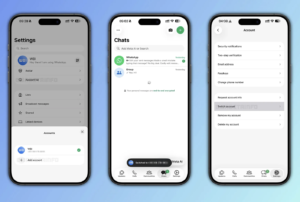
The beta introduces an “Account List” panel nestled within Settings, with some users spotting a shortcut near the familiar QR icon. Switching identities now feels less like a workaround and more like a natural gesture swift, fluid, instinctive.
Adding a second account is refreshingly adaptable. Users may:
- Register a brand-new number
- Attach an existing WhatsApp profile
- Or tether a companion account via QR scan
Once linked, synchronization is immediate. Messages, preferences, and access flow in without interruption. The transition feels less like logging in and more like stepping through a door.
Current Two-Account Limit in the Beta
For now, the beta draws the line at two concurrent accounts. While some power users might hunger for more, this ceiling accommodates the overwhelming majority. In truth, many once managed far messier setups across multiple devices. In comparison, this new constraint feels almost generous.
Meta has a history of loosening limits over time. Expansion is not guaranteed but it’s certainly plausible.
Distinct Settings for Every WhatsApp Identity
Each account maintains sovereign control over its own settings chat archives, backup routines, notification sounds, privacy rules, storage behavior. Nothing bleeds across the boundary.
This architectural separation isn’t merely tidy it’s liberating. You might silence work threads as dusk settles in while personal conversations continue to flutter. Boundaries, once porous, now feel deliberate.
Sharper, Account-Specific Notifications
Notifications now announce their origin clearly. Every alert signals which account summoned it. No more reflex replies sent from the wrong identity. No more awkward explanations.
For professionals, this clarity is not cosmetic it’s reputational armor. A single misfire can bruise credibility. This update quietly eliminates that risk.
The End of WhatsApp Business as a Crutch
For years, WhatsApp Business served as the unofficial second account. Useful, yes—but incomplete. Feature limitations, design inconsistencies, and cognitive friction made the experience feel stitched together.
Native multi-account support renders that dependency largely obsolete. One interface. Full parity. No fragmentation. The ecosystem finally feels whole.
A Subtle Step Toward Username-Based Messaging
This evolution dovetails neatly with WhatsApp’s quiet march toward username-driven communication. A future where phone numbers are optional no longer feels speculative.
Coupled with multi-account support, this shift hints at a more elastic identity framework—one where creators, entrepreneurs, and privacy-conscious users can operate with far greater discretion.
Security and Account Isolation Remain Intact
Despite the dual-account setup, WhatsApp’s security spine stays rigid. Each profile retains its own encryption, authentication, and biometric safeguards. A breach in one does not echo into the other.
Even biometric locks can differ per account, allowing users to selectively fortify one identity while keeping the other frictionless. Control, in this context, becomes granular and deeply reassuring.
Availability and the Likely Public Release Window
At present, multi-account support remains confined to the TestFlight beta tier. Only a segment of users can access it. Yet stability reports have been largely affirmative, with broad device compatibility already observed.
WhatsApp has offered no formal launch date. Still, the cadence of testing suggests momentum. A wide release does not appear distant.
Why This Update Reshapes Workflows for Businesses and Freelancers
For entrepreneurs, the implications are immediate. Client conversations and private messages now coexist on the same handset without operational gymnastics. Device hopping becomes a relic.
Freelancers gain similar leverage faster responses, cleaner segmentation, improved mental organization. Even social media managers, perpetually balancing multiple brands, finally gain a communication environment that respects structure rather than sabotaging it.
What This Signals for the Future of WhatsApp
WhatsApp is no longer content with being a mere messenger. It is steadily refashioning itself into a comprehensive communication infrastructure. Native multi-account support marks another cornerstone in that transformation.
Future iterations may introduce cross-account intelligence, unified cloud backups, or business-focused analytics. What feels like a modest addition today may age into a foundational layer tomorrow.
User Experience Enhancements You’ll Notice Instantly
Account switching is brisk and frictionless. The interface remains uncluttered. Battery consumption shows no dramatic deviation. Even better—the app recalls your last active account, returning you to your exact conversational context without delay.
Small refinements, yes. But small refinements compound.
Who Should Enlist in the Beta Immediately
Anyone dependent on multiple WhatsApp numbers stands to gain: business owners, sales teams, digital marketers, shared-device households.
Casual users may prefer patience. Beta environments, by definition, carry minor instability. That said, current builds appear remarkably well-behaved.
Final Reflections on WhatsApp Multi-Account Support
WhatsApp’s native multi-account capability on iPhone dismantles one of the platform’s most stubborn limitations. It strengthens privacy. It accelerates workflow. It restores a sense of control long denied.
More than anything, it acknowledges modern reality: people don’t live singular digital lives. They inhabit multiple spheres professional, personal, public, private often at the same time. WhatsApp has finally built a system that honors that complexity.
As the global rollout edges closer, anticipation continues to swell. Once this becomes standard, the old way will feel impossibly dated.