

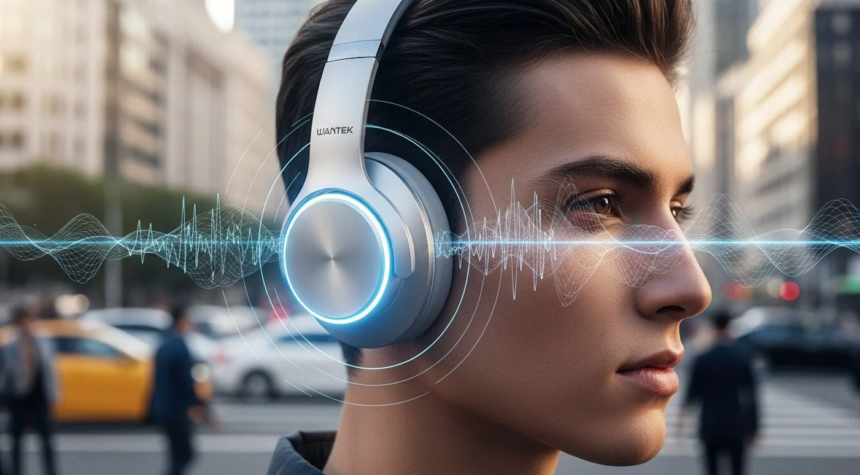
In the landscape of 2026, the definition of audio technology has shifted from mere “noise cancellation” to “intelligent isolation.” For decades, the primary goal of premium headphones was to block the world out. Today, a new era of AI headphones technology is focused on a much more complex challenge: letting the right sounds in. This evolution is particularly transformative for the “cocktail party problem,” a phenomenon where the human ear struggles to isolate a single conversation amidst a sea of background chatter.
The latest generation of hearables is powered by advanced machine learning models that do more than just dull the ambient hum of a crowded cafe. They proactively identify, isolate, and amplify the voices that matter to you. By blending computational audio with human intent, these devices are turning chaotic environments into intimate spaces for connection. In this expert guide, we will explore the core pillars of AI headphones technology and how they are redefining the way we hear the world.
1. Solving the Cocktail Party Problem
The most significant breakthrough in 2026 audio engineering is the ability to solve the “Cocktail Party Effect” using proactive AI. Traditional Active Noise Cancellation (ANC) is excellent at neutralizing constant, low frequency sounds like airplane engines or air conditioners. However, it often fails to distinguish between a person speaking to you and a person speaking behind you.
- Target Speaker Extraction (TSE): New algorithms, such as “Listen to Extract” (LExt), allow headphones to enroll a specific voice in real-time. By analyzing a few seconds of a partner’s speech, the AI creates a unique vocal fingerprint, allowing it to suppress all other competing voices while keeping your partner’s voice crisp and clear.
- Turn-Taking Cadence Analysis: Researchers at the University of Washington have pioneered “Proactive Hearing Assistants.” These AI models track the natural rhythm of human conversation. Since participants in a chat typically take turns with minimal overlap, the AI can identify who you are talking to simply by following the “who spoke when” pattern.
- Spatial Voice Anchoring: Using binaural microphones, the AI can “lock” onto a specific location. If you are sitting across from a colleague, the headphones create a “sound bubble” that prioritizes audio from that specific 45 degree angle while fading out the rest of the room.
2. The Tech Stack: How AI Headphones Work
The internal architecture of a 2026 flagship headphone is more akin to a high performance computer than a traditional speaker. Several layers of technology work in sync to process audio in under 10 milliseconds a speed necessary to avoid the disorienting “audio lag” that plagued earlier prototypes.
Neural Processing Units (NPUs)
Modern headphones now feature dedicated AI chips, such as the Phonak DEEPSONIC or Apple’s H2 and H3 iterations. These chips are designed specifically for deep learning tasks. They run neural networks that have been trained on millions of multilingual voice samples, allowing them to distinguish between speech, music, and environmental noise with 99 percent accuracy.
Multi-Microphone Beamforming Arrays
To capture clean data for the AI to process, 2026 headphones utilize six to eight high definition microphones. These mics work in “Beamforming” arrays, which act like a virtual spotlight for sound. By calculating the “Time of Arrival” of sound waves at different microphones, the system can determine the exact origin of a voice and isolate it from reflections bouncing off walls.
Comparison: Traditional ANC vs. 2026 AI Voice Isolation
| Feature | Standard ANC (2020) | AI Voice Isolation (2026) |
| Noise Profile | Static (Engine Hum/Fans) | Dynamic (Crowds/Clatter) |
| Voice Handling | Muffles all voices | Selectively Amplifies Target Voice |
| Latency | 50 to 100ms | Sub-10ms (Real-Time) |
| Hardware | Basic Digital Signal Processor | Dedicated Neural Processing Unit |
| User Control | Manual Mode Switching | Proactive Intent Detection |
3. Real-Time Translation: Breaking the Language Barrier
A core feature of AI headphones technology in 2026 is the integration of Neural Machine Translation (NMT). This has transformed travel and international business by providing a “personal interpreter” in your ear.
- Contextual Interpretation: Unlike early translators that used word-for-word substitution, 2026 models use Large Language Models (LLMs) to understand idioms, tone, and cultural nuances. If someone says “it’s raining cats and dogs,” the AI translates the meaning of heavy rain rather than the literal animals.
- Natural Voice Synthesis: The translated audio is no longer a robotic “text-to-speech” voice. AI now synthesizes a natural, human-like voice that matches the speaker’s original pitch and cadence, making the conversation feel much more authentic.
- Offline Processing: To protect privacy and ensure reliability during travel, many of these translation models now run “on-device.” This means your private conversations are never sent to a cloud server for processing.
4. Accessibility and “Hearable” Evolution
The line between consumer electronics and medical devices has officially vanished. For the millions of people with mild to moderate hearing loss, AI headphones technology provides a discreet and powerful alternative to traditional hearing aids.
- Reduced Listening Fatigue: One of the most exhausting parts of hearing loss is the mental effort required to decode speech in noisy rooms. By doing the “filtering work” for the brain, AI headphones significantly reduce cognitive load and social anxiety in loud settings.
- Adaptive Transparency: 2026 headphones feature “Context Aware” transparency modes. If the AI detects a siren or someone calling your name, it will automatically dip your music and amplify the external alert, ensuring you stay safe while remaining immersed in your audio.
- Biosensor Integration: Some “Hearables” now include sensors to monitor heart rate, stress levels, and even brainwave activity (BCI). If the AI detects your stress levels rising in a loud environment, it can automatically increase noise cancellation and suggest a “focused audio” track to help you calm down.
5. Privacy and the “Ethics of Hearing”
As headphones become more capable of picking up distant conversations, the tech industry is facing new ethical questions. Leading brands in 2026 have implemented “Privacy Guard” features to ensure this technology is used responsibly.
- Consent Handshakes: Some high-end models are experimenting with “Digital Handshakes.” If both people are wearing compatible AI headphones, the devices exchange a token that allows for enhanced voice isolation.
- Local Data Storage: By performing all AI calculations on the internal NPU, manufacturers ensure that your vocal “fingerprint” and the contents of your conversations remain on the device and are never shared with advertisers.
Conclusion
The rise of AI headphone technology represents a fundamental shift in how we interact with our environment. We are no longer passive listeners to the world’s noise; we are active curators of our own “soundscapes.” By leveraging neural processing, beamforming arrays, and intent-based algorithms, the headphones of 2026 have finally solved the age-old problem of the crowded room.
Whether you are using this technology to close a business deal in a busy airport, translate a local menu in a foreign country, or simply hear a loved one’s voice over the din of a restaurant, the power of intelligent audio is undeniable. As we look toward the future, these “Proactive Hearing Assistants” will continue to shrink in size and grow in intelligence, eventually becoming an invisible yet indispensable layer of our daily lives.