Fact-checking organizations have become an increasingly visible part of the modern information landscape, regularly evaluating claims made by public figures, viral social media posts, and news stories. Yet the actual process these organizations use to investigate and verify claims often remains genuinely unclear to the people relying on their conclusions. This article explains how legitimate fact-checking organizations actually approach their work.
What Fact-Checking Organizations Actually Do
Fact-checking organizations investigate specific, checkable claims, statements of fact that can genuinely be verified or disproven through evidence, rather than matters of opinion or genuinely subjective interpretation. This distinction matters considerably, since fact-checkers generally focus on claims like specific statistics, quotes, or described events, rather than attempting to adjudicate broader questions of political or social opinion where reasonable people can genuinely disagree.
Reputable fact-checking organizations typically publish their specific methodology publicly, along with detailed explanations of how they reached each individual conclusion, allowing readers to evaluate the reasoning behind a rating rather than simply trusting an unexplained verdict.
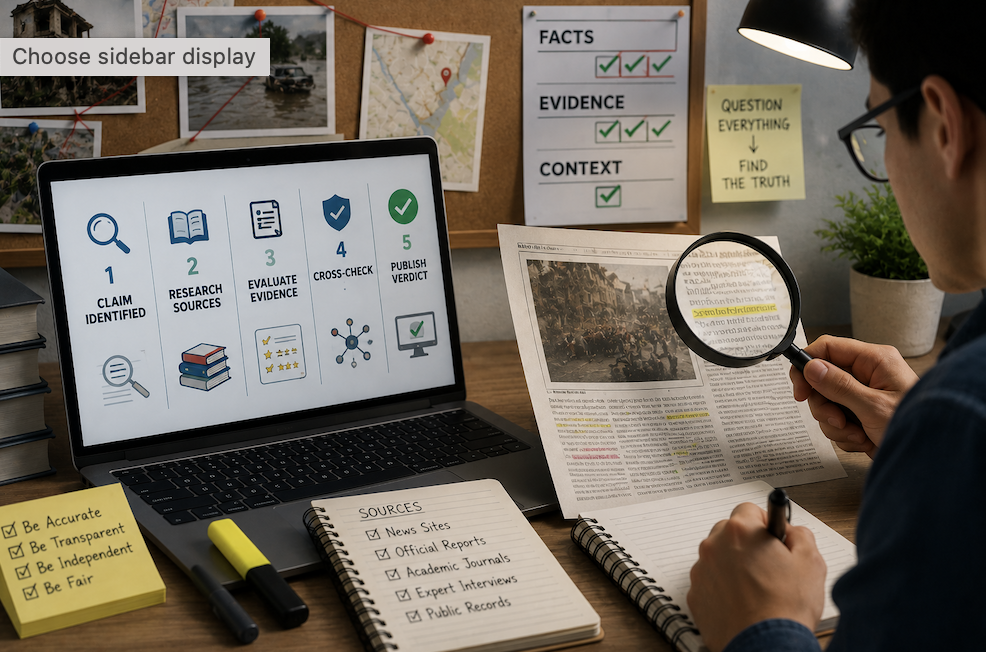
The General Process a Thorough Fact-Check Typically Follows
While specific approaches vary somewhat between different organizations, most legitimate fact-checking processes follow a broadly similar general structure aimed at genuine, evidence-based verification.
- Identifying a specific, checkable claim rather than a broad, subjective statement
- Tracing the claim back to its original source rather than relying on secondhand summaries
- Gathering primary source evidence, such as official documents, data, or direct statements
- Consulting relevant experts or authoritative sources with genuine, verifiable expertise on the specific topic
- Evaluating the overall weight and quality of gathered evidence before reaching a conclusion
- Publishing the specific methodology and evidence alongside the final rating or conclusion
This process is considerably more involved than simply asking whether a claim sounds plausible, and thorough fact-checks often take meaningful time and research effort, particularly for claims involving specialized or technical subject matter.
Why Tracing Claims Back to Original Sources Matters So Much
One of the most important, and most frequently skipped, steps in casual claim evaluation involves tracing a specific claim back to its actual original source rather than relying on how it has been summarized, paraphrased, or characterized by intermediate sources along the way.
Claims often shift meaningfully as they get repeated and summarized across multiple sources, sometimes losing important context or nuance present in the original statement. A thorough fact-check specifically prioritizes locating the original source, whether that is an official document, a direct quote, or primary data, rather than evaluating a claim based on how a third party has already characterized it.
- Claims frequently lose important context or nuance as they get repeated across multiple sources
- Original sources provide the most reliable basis for genuine, accurate verification
- Secondhand summaries and characterizations can introduce subtle but meaningful distortions
- This step alone often resolves claims that initially appeared more significant or dramatic than the original source actually supports
How Fact-Checkers Handle Genuinely Ambiguous or Complex Claims
Not every claim fits neatly into a simple true-or-false verdict, and legitimate fact-checking organizations typically use nuanced rating systems that reflect genuine complexity rather than forcing every claim into an oversimplified binary judgment.
- Ratings often include categories like “mostly true,” “misleading,” or “lacks context” alongside simple true or false
- Complex claims frequently receive detailed explanations addressing which specific parts are accurate versus inaccurate
- Genuinely uncertain or unresolved questions may be explicitly acknowledged as such rather than forced into a false certainty
- This nuanced approach reflects the genuine reality that many real-world claims contain a meaningful mix of accurate and inaccurate elements
Why Methodology Transparency Genuinely Matters for Trust
Legitimate fact-checking organizations generally publish detailed explanations of their specific reasoning and evidence alongside each conclusion, allowing readers to evaluate the actual quality of the investigation rather than simply trusting an unexplained verdict from an unfamiliar source.
This transparency serves an important accountability function, since it allows readers, and other fact-checkers, to identify potential errors or gaps in reasoning, and it allows the fact-checking organization itself to build genuine credibility through a consistent, demonstrated track record rather than relying purely on institutional reputation alone.
- Published methodology allows readers to evaluate the actual quality of reasoning behind a conclusion
- This transparency creates meaningful accountability for the fact-checking organization itself
- A consistent, demonstrated track record builds genuine credibility over time
- Organizations lacking this transparency deserve more skepticism regardless of how authoritative they may appear
Genuine Limitations Even Legitimate Fact-Checking Faces
Fact-checking organizations, even well-intentioned and methodologically rigorous ones, face genuine limitations worth understanding. Choosing which claims to investigate in the first place involves some degree of editorial judgment, and even careful, evidence-based analysis can occasionally reach conclusions that later require correction as new information emerges.
- Selection of which claims to investigate involves inherent editorial judgment about relevance and significance
- Even careful, evidence-based conclusions can occasionally require later correction as new information emerges
- Genuinely complex or rapidly evolving situations can be more difficult to definitively fact-check in real time
- No single organization should be treated as infallible, even when their general methodology appears rigorous
How to Evaluate Whether a Fact-Checking Source Is Genuinely Reliable
- Check whether the organization publishes detailed methodology and evidence, not just a bare conclusion
- Look for a demonstrated track record and willingness to publish corrections when errors occur
- Consider whether the organization discloses funding sources and any potential conflicts of interest
- Compare conclusions across multiple independent, reputable fact-checking organizations for particularly significant claims
Why Fact-Checkers Distinguish Between Facts and Opinions So Carefully
A genuinely important, and sometimes underappreciated, aspect of legitimate fact-checking involves the deliberate, careful distinction between checkable factual claims and matters of genuine opinion or subjective interpretation, since conflating these two categories undermines the entire credibility and purpose of the fact-checking exercise itself.
A statement like a specific statistic, a direct quote, or a description of a documented event represents a genuinely checkable factual claim, since evidence can be gathered to confirm or refute it. A statement expressing a value judgment, a prediction about future events, or a policy preference generally falls outside what a rigorous fact-check can legitimately adjudicate, since these involve genuine, reasonable disagreement rather than a simple question of factual accuracy. Reputable fact-checking organizations are careful to focus their efforts specifically on the former category, avoiding the credibility-damaging trap of presenting subjective opinion as if it were an objectively verifiable fact.
- Checkable factual claims include specific statistics, direct quotes, and documented events
- Genuine opinions, predictions, and value judgments generally fall outside what fact-checking can legitimately adjudicate
- Conflating these two categories undermines the credibility and purpose of legitimate fact-checking
- Careful, consistent distinction between these categories is a hallmark of genuinely rigorous fact-checking practice
Final Thoughts
Legitimate fact-checking involves considerably more rigor than simply judging whether a claim sounds plausible, relying instead on tracing claims to original sources, gathering primary evidence, consulting genuine expertise, and publishing transparent methodology that allows readers to evaluate the reasoning behind each conclusion. Understanding this actual process helps you more effectively evaluate which fact-checking sources genuinely deserve your trust, and gives you a practical framework for approaching your own everyday claim verification more carefully.
- Read more about Techsipra!
Frequently Asked Questions
1. Are all fact-checking organizations equally reliable and unbiased?
No, quality and rigor vary considerably between organizations, which is exactly why evaluating a specific organization’s methodology, transparency, and track record matters more than assuming all fact-checkers are equivalent.
2. Can fact-checking organizations get things wrong?
Yes, even careful, methodologically rigorous fact-checking can occasionally reach conclusions that later require correction as new information emerges, which is why reputable organizations generally have clear processes for publishing corrections when genuine errors occur.
3. Why do some claims receive nuanced ratings instead of simple true or false verdicts?
Because many real-world claims genuinely contain a mix of accurate and inaccurate elements, or require important context to properly evaluate, and forcing every claim into an oversimplified binary judgment would misrepresent this genuine complexity.
4. How long does a thorough fact-check typically take to complete?
This varies considerably depending on the claim’s complexity and how accessible relevant evidence and expert sources are, ranging from relatively quick verifications for straightforward, well-documented claims to considerably longer investigations for technical or contested topics.
5. Should I trust a fact-check without doing any of my own verification?
Reputable fact-checking with transparent, published methodology provides a genuinely valuable starting point, though for particularly significant claims, reviewing the actual evidence and reasoning provided, rather than just trusting the final verdict, remains a reasonable additional step.